
Urban Planetary Health: The Komb Green Solutions Story
For three decades, a stretch of the Nairobi River was defined by three intersecting crises: environmental degradation, poverty, and crime. Now, reformed young people once involved in crime are greening and feeding their community through regenerative, community-driven restoration.
The Problem: A Confluence of Waste and Crime
The riverbank along Korogocho, an informal settlement in Nairobi, Kenya, long suffered from deep-seated, systemic challenges that threatened both the local ecosystem and the community’s youth. For more than 30 years, solid and human waste piled up directly next to residential homes, creating severe health hazards for poor families that lacked financial and political resources to do something about it. Compounding these conditions, residents were subjected to severe flooding during heavy rains, largely because settlement and dumping had stripped the river of its natural vegetation and floodplain.
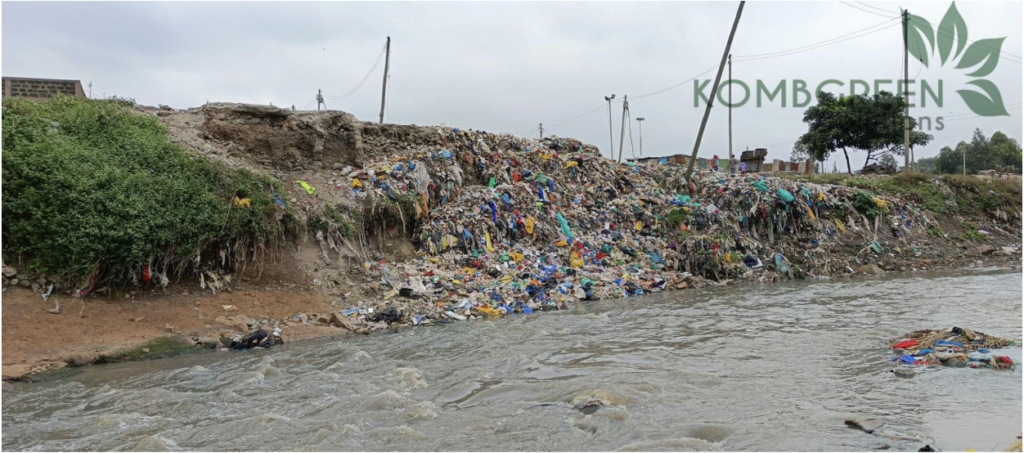
1 This riverbank served as an open dumpsite and hiding place for youth pushed into crime for decades.
For decades, this dumpsite doubled as a hiding place for youth involved in illicit activities, driven by high unemployment and the desperate pressure to survive through crime. Tensions only heightened after the construction of a bridge linking the neighboring communities of Korogocho and Dandora. Though funded by Italian cooperation to improve movement across the river, the bridge unfortunately increased local anxieties over safety, waste management, and control of the riverbank. With an ever-increasing number of young people from the area lost to crime and violence, including a locally reported loss of more than 50 youths, the community lived in constant fear, lacking visible economic alternatives or a safe public space to call their own.
The Solution: Youth Rebuild a Riverfront and Future
In June 2017, ten young people — many of them formerly involved in theft and other petty crimes — decided to rewrite this narrative by forming a community-based initiative dedicated to “flipping” the dumpsite into a safe, green public space. They called themselves “Komb Green Solutions”, signaling a new identity rooted in environmental restoration rather than crime.
Over the course of a year, Komb Green organized systematic cleanups to remove decades of accumulated waste, constructed gabions to stabilize the eroding riverbank, and planted grass and trees to create what is now the vibrant Korogocho People’s Park. They also planted bamboo across sections of the riverbank to help reduce erosion, store carbon, and support long-term restoration.
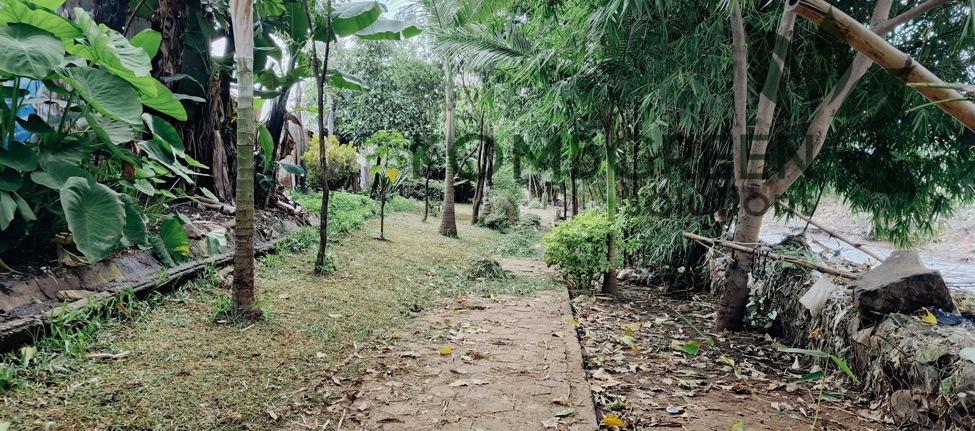
2 Reclaimed riverbank in Korogocho, now a green corridor instead of a dumpsite.
Building on this initial success, Komb Green replicated their model across the wider Korogocho area, successfully reclaiming five additional neglected spaces and transforming them into small recreation parks. To sustain this physical restoration, they designed a holistic suite of programs that include urban farming, hydroponics, youth mentorship, community sensitization, and even a feeding program for local children. Komb Green has also developed urban farming systems using hydroponics and other low-space techniques, turning a small shed into a productive garden. They complement this with organic waste recycling, using insects that feed on food scraps and other biodegradable materials to rapidly break down waste and produce nutrient-rich inputs for their gardens. Together, these practices help reduce the volume of trash heading to informal dumpsites while creating more reliable local food.
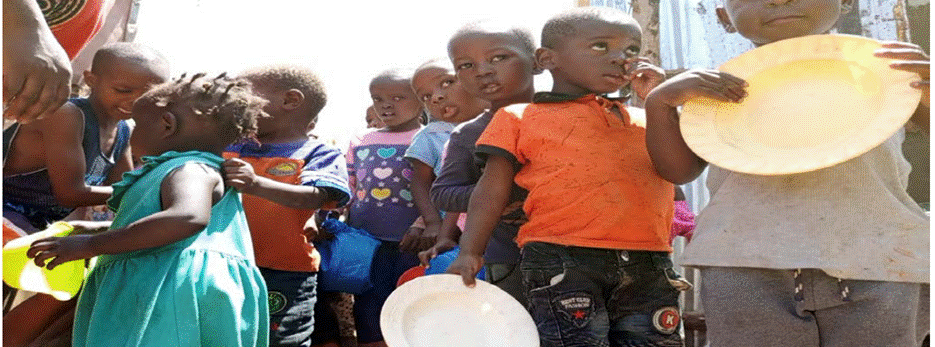
3 Local children gather at Komb Green’s site, waiting for the community feeding program to begin.
Their work has expanded well beyond park restoration. Komb Green reports a 90 percent reduction in crime in their immediate area and has trained more than 600 youths across Nairobi on the importance of reclaiming riparian land and ecosystems, later awarding them with certification. Through a partnership with Buildher, the group has empowered 640 women by training them in joinery, carpentry, painting, tiling, and interior design, creating pathways to economic independence. At the same time, Komb Green continues to face major constraints, including operating on public land, ongoing pollution of the Nairobi River, air pollution from nearby dumpsites, lack of medical cover and protective gear for members, and insufficient resources to scale their projects. Their stated needs include a transportation vehicle for exchange programs, welding and plastic-crushing machines, and a safe social resource center.
By intentionally linking ecosystem restoration to local livelihoods, Komb Green Solutions has proven that environmental rehabilitation can be a direct pathway to safety, skills, and economic resilience. Their approach ensures proper local waste management while simultaneously creating tangible income-generating opportunities that allow young people to permanently move away from crime and dependency. The impact of their work is profound; the team reports a remarkable 90 percent drop in crime in their immediate area. Furthermore, their reach has expanded far beyond their own neighborhood, as they have trained more than 600 youth across Nairobi on how to reclaim riparian land, using the Korogocho People’s Park as visible proof that healing the land can heal a community.
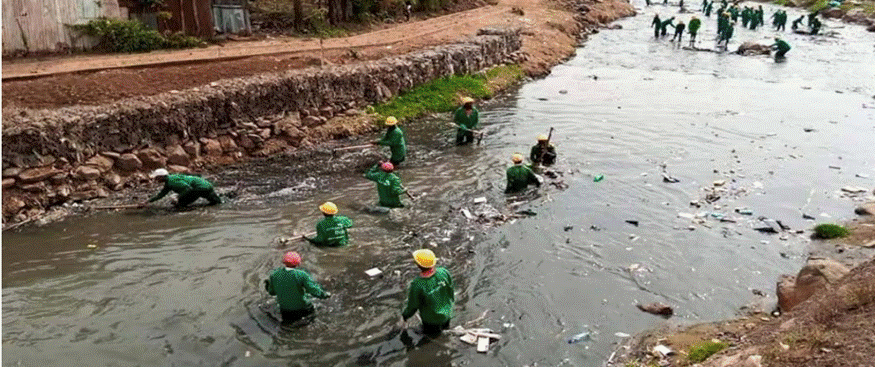
4 Komb Green youth cleaning up the riverbank.
Komb Green Solutions is a living testament to what any community can achieve when local youth take ownership of their environment and future. Their contributions to their local community and to the world make Komb Green Solutions a solution that Earth Team wishes to spotlight, support, and help scale. For more information on Komb Green Solutions to learn or help: contact CEO Fredrick Okinda via email at [email protected].