
Paid to Protect: How EarthTeam Is Closing the Gap Between Frontline Work and the Money Meant to Fund It
Fred grew up beside the Nairobi River in Korogocho, where survival sometimes meant
snatching purses. Today he helps lead Komb Green Solutions, the youth group that turned
a 30-year dumpsite into Korogocho People’s Park. Its members now grow food, stabilise
riverbanks and plant bamboo where garbage once piled up.
Fred’s story is not unusual, and that is the point. Across the world, millions of people living
beside the last forests, rivers and wildlife populations are the same people extraction
recruits. Around 831 million people live on less than $3 a day, and 3.5 billion on $7 or less.
Poverty and a sick planet aren’t two problems. They’re one.
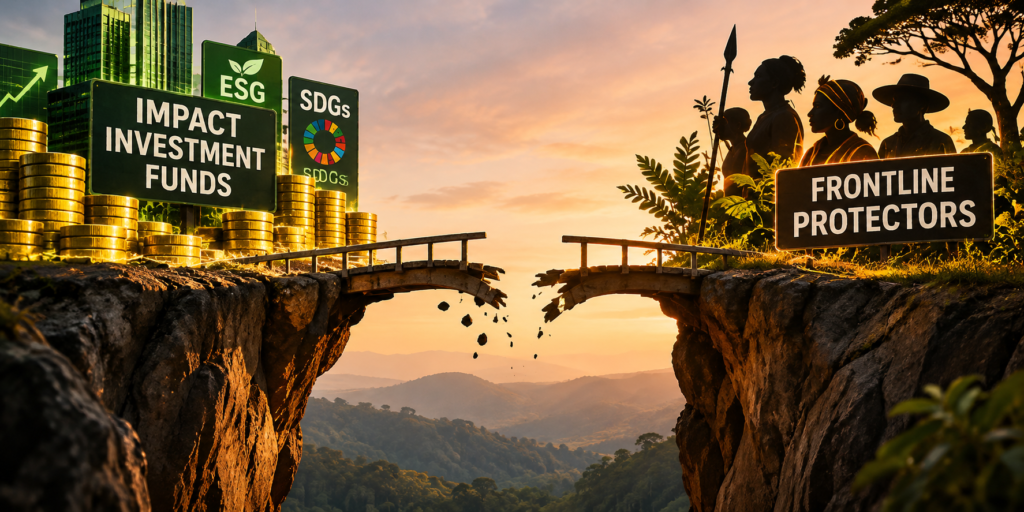
The money exists. It just doesn’t arrive.
According to UNEP, US$220 billion supported nature-based solutions, with private finance
contributing just US$23 billion. Public domestic spending accounts for nearly 90% of that
total, leaving it vulnerable to government budget cuts. Very little reaches community
groups, rangers, smallholder farmers or the small NGOs doing the work on the ground.
Sources: UNEP – State of Finance for Nature 2026 UNEP – State of Finance for Nature 2026 | IASgyan – World spends more on destroying nature than saving it IASgyan – World spends more on destroying nature than saving it
The reason is a two-way information gap. Frontline groups don’t know where the funding
is or how to qualify for it. Funders don’t know the frontline groups exist, or can’t afford to check their work. Traditional verification is slow, expensive and built for large institutions.
A community group planting a riverbank can wait years for recognition, if it ever comes.
How the EarthTeam app works
- Add your project. Any protector can name a project, describe the problem and
action, pin the location, upload photos and evidence, and say what support they
need. This includes NGOs, ranger teams, farmers, teachers and students, and
individuals. - Get verified. Every submission goes through three layers. gAIa AI checks
consistency and flags anomalies, community verifiers weigh in, and an expert panel
reviews and confirms. Indicators are aligned with the SDGs and with nature-credit
standards. - Get found. Verified projects appear on a global map, so donors, companies and
the public can search by location, impact score and need. - Reuse your data. One upload produces a funder-ready report in one click.
Groups can use it for proposals, updates and social media instead of rebuilding the
same information for every grant.
Rewarded as you go
Protectors earn EarthCredits for sharing, taking action, verifying others’ work and proving
impact, so recognition arrives step by step rather than only at the end. Today, EarthCredits
serve as a badge of honour, a certificate of verified impact and evidence for grant
applications. Future pathways include nature-credit markets and a pooled EarthTeam
impact bundle; these are a development trajectory, not current functionality.
What’s next
The app is in beta now, with public launch planned for March 2027. Frontline groups can
register early and put their work on the map.
JOIN THE BETA → email to [email protected]